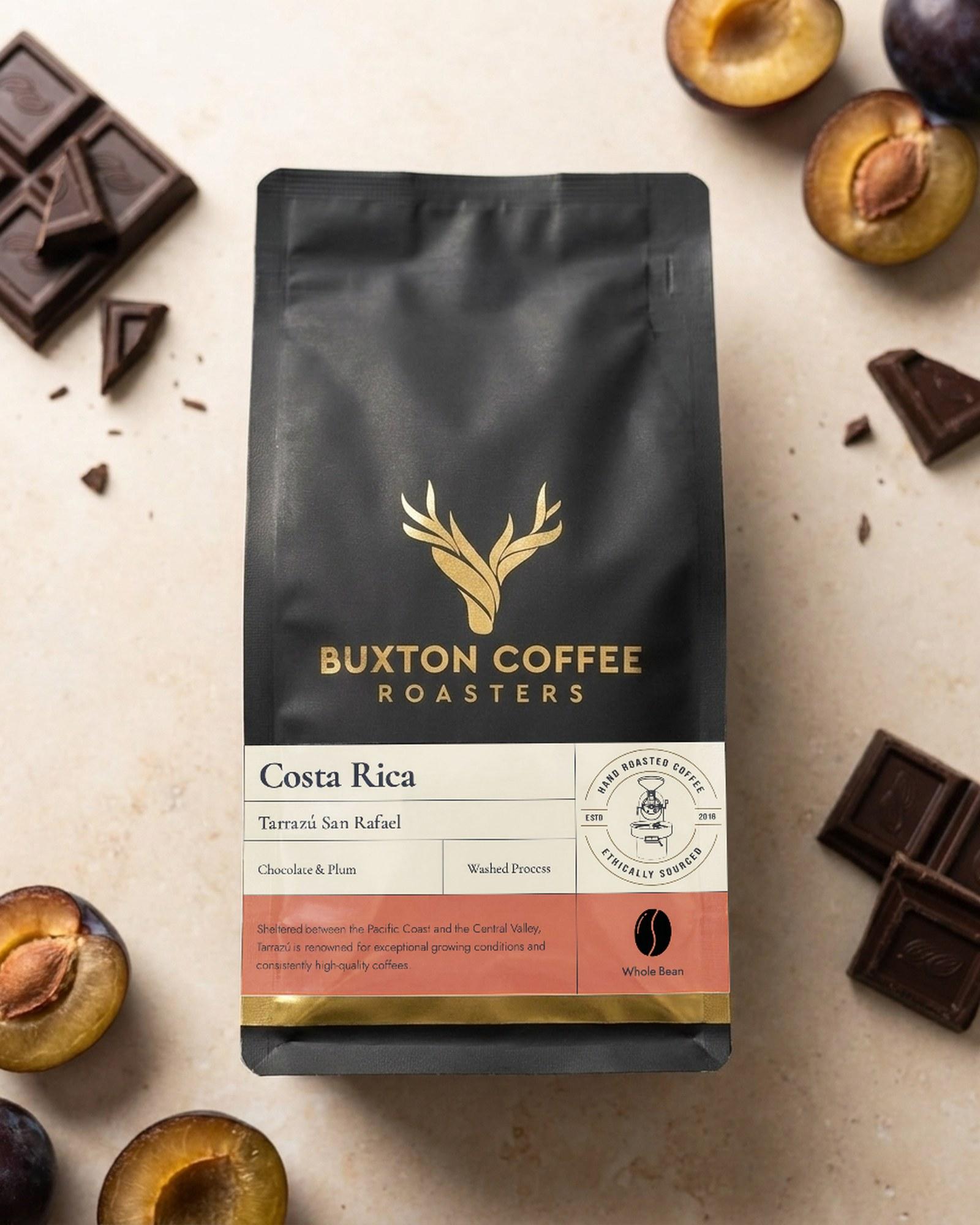
COSTA RICA TARRAZU SAN RAFAEL
Plum, Chocolate
£7.25

All Coffees
Not sure where to start?
There are no hard rules — it comes down to what you enjoy. The one question we always ask is whether you drink your coffee with or without milk. If you take milk, start with our nuttier or chocolatey coffees, which pair with it better. Fruitier coffees tend to shine without milk. Beyond that, it’s all about how you like it.
You’ll notice we never mention “strength” — it’s a rather outdated term. It really refers to how much robusta a coffee has been blended with; robusta is very bitter, and that bitterness gets rebranded as “strong”. We only ever use 100% Arabica. How strong your cup tastes has far more to do with how you brew it — particularly your brew ratio, i.e. how much water to coffee. Pick the flavour you love, then make it as strong or as weak as you like.
We don’t label our coffee by roast level either — with high-quality Arabica we think it’s an outdated metric. Dark roasting is really used to mask the harshness of lower-quality beans like robusta; with good Arabica there’s nothing to roast out. That leaves “light” and “medium”, which are subjective, arbitrary terms. We roast on Probat roasters — considered the best in the world — which give us precise control and detailed data. The metric that matters to us is the development percentage: an accurate, repeatable value we work to, from 16% (lightest) up to 22% (darkest). Two coffees roasted identically can still look quite different, so we let the coffee itself dictate how it’s roasted, sampling at every percentage point to find where it’s at its best. Watch our video explaining development percentage.
We generally don’t grind for espresso machines. The perfect espresso grind is specific to your particular machine and setup, so it’s all but impossible for us to get it exactly right for you. For espresso we’d recommend whole bean and grinding fresh at home.
Not sure where to start?
There are no hard rules — it comes down to what you enjoy. The one question we always ask is whether you drink your coffee with or without milk. If you take milk, start with our nuttier or chocolatey coffees, which pair with it better. Fruitier coffees tend to shine without milk. Beyond that, it’s all about how you like it.
You’ll notice we never mention “strength” — it’s a rather outdated term. It really refers to how much robusta a coffee has been blended with; robusta is very bitter, and that bitterness gets rebranded as “strong”. We only ever use 100% Arabica. How strong your cup tastes has far more to do with how you brew it — particularly your brew ratio, i.e. how much water to coffee. Pick the flavour you love, then make it as strong or as weak as you like.
We don’t label our coffee by roast level either — with high-quality Arabica we think it’s an outdated metric. Dark roasting is really used to mask the harshness of lower-quality beans like robusta; with good Arabica there’s nothing to roast out. That leaves “light” and “medium”, which are subjective, arbitrary terms. We roast on Probat roasters — considered the best in the world — which give us precise control and detailed data. The metric that matters to us is the development percentage: an accurate, repeatable value we work to, from 16% (lightest) up to 22% (darkest). Two coffees roasted identically can still look quite different, so we let the coffee itself dictate how it’s roasted, sampling at every percentage point to find where it’s at its best. Watch our video explaining development percentage.
We generally don’t grind for espresso machines. The perfect espresso grind is specific to your particular machine and setup, so it’s all but impossible for us to get it exactly right for you. For espresso we’d recommend whole bean and grinding fresh at home.